

I’m walking 100K in March for families facing baby loss
I’ve committed to walking 100K in March for every much-loved baby sadly not here today.
Sands ensure that everyone affected by the loss of a baby gets the support they need and deserve when facing the toughest of times. They campaign for change, provide training for midwives and healthcare professionals, and support research so that fewer babies die and so that less families experience the tragedy of losing their baby. Anything you are able to donate means so much.
Thank you.
My Activity Tracking
106
kms
My target 100 kms
My Achievements

Updated Profile Picture
Donated to myself

Shared page

Received First Donation
First walk logged
Received 10 donations
Increased Fundraising Target
Completed 100km
My Updates
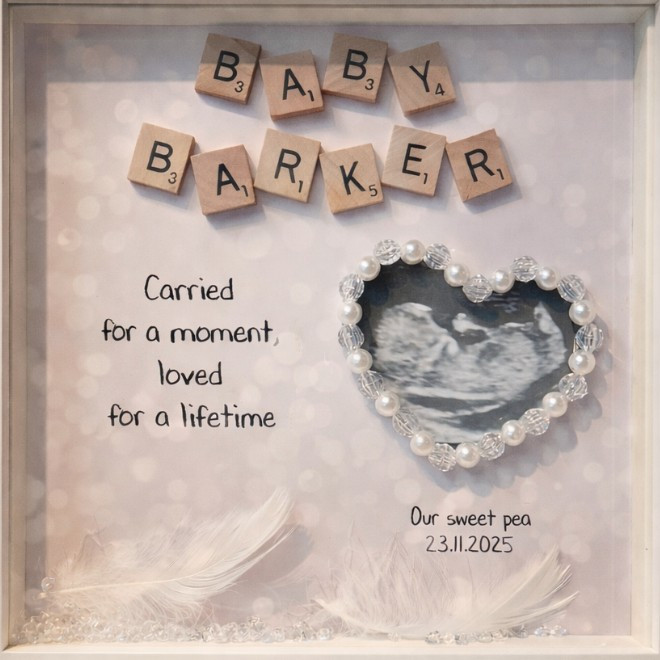
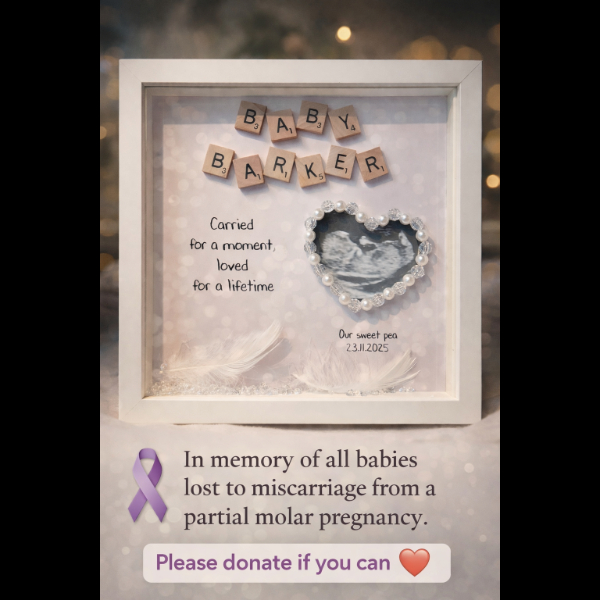
Letter to our baby - Born 23.11.25
Monday 9th FebTo our angel baby,
How i wish you could have met your brothers...
I only knew you for a moment, but you changed me forever.
I saw your heartbeat. I saw proof that you were here, that my body tried to make space for you, even if it couldn’t keep you. I want you to know that you were wanted from the very beginning.
I’m sorry I didn’t get more time with you. I’m sorry your life was measured in flickers instead of years. I’m sorry the world never got the chance to know you the way I did, even briefly.
You were real to me.
You were loved.
You were never just a diagnosis—or a complication—or a condition.
I carry you in the quiet moments—in the pause before hope, in the tenderness I didn’t have before you came and left. You existed. And because you did, I am not the same.
Goodbye, my little one.
You mattered. You're Loved. You always will be!
Share
Two Days Between a Heartbeat and Goodbye
Monday 9th FebNo one talks about missed miscarriages.
You don’t always know when your baby Is gone.
Sometimes, your body holds on.
Sometimes, your heart still hopes.
Sometimes, you walk into that appointment expecting to hear a heartbeat and instead you hear silence.
No cramping, no bleeding, no warning…
Just a heartbreaking discovery that your baby’s heart stopped beating, but your body didn’t get the message.
They don’t tell you how hard it is to carry life that’s no longer there.
How cruel it feels to still feel pregnant when your baby is already gone.
How broken you feel making choices you never thought you’d face like waiting it out or intervening
They don’t tell you how quiet the ride home feels or how your hand still rests on your belly out of habit.
How deeply you grieve someone you never got to meet!
Pregnancy loss doesn’t always arrive with drama or warning. Sometimes, it comes silently hidden behind hope, ultrasound photos, and the assumption that everything is progressing as it should. Two experiences that often unfold this way are missed miscarriage and partial molar pregnancy. They are medically distinct, but emotionally, they share a painful thread: loss discovered after trust has already settled in.
I saw the heartbeat.
It was there on the ultrasound screen, small and flickering, but unmistakably real. In that moment, everything inside me softened. I let myself believe we were safe.
Excited to share the news with our two boys, family & friends.
Until the sonographer explained there could be a problem, we waited for a midwife to come and explain, my heart was heavy watching all the other couples leaving the rooms with smiles whilst our minds worked overtime.
We were told of the possible complications but that everything could be fine we just need to go for further scans, I felt sick, I replayed the image from the ultrasound in my mind over and over—the rhythm of it, the proof, I was clinging to hope.
Two days later, we were told there was no heartbeat.
There was no slow decline. No warning. No emotional runway to prepare for the fall. Just a before and an after that didn’t make sense together. I remember sitting there thinking they must have made a mistake.
But they Hadn’t.
I learned the words missed miscarriage in a room where the air suddenly felt too heavy to breathe. The ultrasound screen was there, but the explanation came first, carefully delivered, like bad news always is. The pregnancy had stopped developing, my body just hadn’t let go, devastating not just because of the loss itself, but because of the shock. The body feels pregnant. The mind has already imagined a future. There was no dramatic moment leading up to it. No bleeding. No warning signs. Just trust—followed by shock.
They explained that my body hadn’t recognized it yet. That sometimes this happens. That sometimes the body holds on even when the life has already gone.
The term “missed” can feel cruel. Nothing about the loss was missed by the person experiencing it.
I felt betrayed by the memory of that heartbeat. By how real it had been. By how cruel it felt to be shown life and then have it taken almost immediately after I let myself believe in it.
I was admitted to hospital to have a medically managed miscarriage, I passed the baby on 23rd November 2025, we got to spend some time with baby and say our goodbyes whilst trying to process our emotions, I lost a scary amount of blood which left me weak and unwell, coming home with injections and boxes upon boxes of medication, I felt dizzy just getting up from the sofa for about a month, often feeling upset and anxious that I was struggling to do anything for our two boys at home.
We attended a funeral for our baby, this day was tough, it hit us hard but was comforting at the same time.
After the miscarriage, the loss didn’t end. It became clinical.
No one prepares you for labour pains after a miscarriage. A week later, when you think the worst has already happened you get pain worsening with every minute, the grief barely settled and yet there you are again – doubled over, breathing through waves of pain that feel hauntingly familiar– I had flashbacks from being in labour with my first baby getting to 6cm and the contractions being thick and fast not leaving any respite – this was how I felt, but how, I wasn’t pregnant anymore. It felt cruel, unjust and lonely to have labour pains without a baby at the end of them.
There are pains you can prepare for, and there are pains that arrive like a betrayal.
I was never given an answer to these pains but discovered I had acquired Ovarian cysts in the midst of all this. From the outside I looked like a woman with cramps, on the inside it felt like my body was at war with itself.
Later, came another layer. Another diagnosis.
This wasn’t just a missed miscarriage. It was a partial molar pregnancy.
A partial molar pregnancy is rarer and more complex. It happens when an embryo forms with an abnormal number of chromosomes—usually due to two sperm fertilizing one egg.
In partial molar pregnancies, placental tissue grows abnormally, sometimes alongside an embryo that may appear to be developing early on. This can make the diagnosis especially confusing and heartbreaking, because the pregnancy can look “real” for weeks before problems are detected.
A partial molar pregnancy is part of something called gestational trophoblastic disease (GTD)—a group of rare conditions where tissue that should become the placenta grows abnormally.
What many people don’t realize is that GTD is classified as a form of cancer. Not the kind people usually imagine, but cancer nonetheless—cells growing when they shouldn’t, in ways that can be dangerous if left behind.
That word—cancer—landed heavily. It felt surreal to be grieving a pregnancy while also being told my body might continue behaving unpredictably. That even after the loss, I wasn’t fully safe yet.
With a partial molar pregnancy, the loss didn’t end when the pregnancy did. It meant that after the pregnancy ended, I couldn’t simply grieve and move on. There were follow-up tests. Blood draws. Waiting for hormone levels to fall. Waiting for permission to move forward. My body had to be monitored. My hormone levels had to be tracked. I had to prove, through blood tests and waiting, that every last bit of abnormal tissue was gone.
Adding months of emotional limbo to an already painful experience.
And then there was the bleeding.
Haemorrhaging doesn’t feel dramatic at first, it feels confusing. You tell yourself it will slow down, you tell yourself this must be normal, but when the blood doesn’t stop – when it soaks through clothes, when the dizziness creeps in – fear replaces denial.
Sitting in A&E, four hours of feeling the warmth of the blood leaving my body, four hours of explaining and re-explaining, four hours of growing weaker in a chair, being left to bleed in a busy room while surrounded by people who didn’t seem to understand made me feel small and dismissed. A partial molar pregnancy already carries grief -the loss of your baby, the shock of abnormal results, the fear of what comes next. Add ovarian cysts swollen from extreme hormone levels, add hours of waiting whilst haemorrhaging and trust in the system fractures, not just fighting for your own body but fighting to be heard.
And even after the bleeding stops, something lingers. A memory in the body. A quiet anxiety. A new awareness of how fragile things can be and how alone can you feel in a crowded room.
I was told I had to wait before trying again—not because my heart wasn’t ready, but because my body had done something dangerous without meaning to. Because even in loss, there were risks to watch for, my body needed proof it was no longer at risk.
It felt like grief with homework.
Grief with appointments.
Grief that needed evidence.
That diagnosis came with more words, more explanations, more fear. Chromosomal abnormalities. Abnormal placental tissue. A pregnancy that looked real enough to believe in, but could never become a healthy baby, even though it tried. Even though there had been a heartbeat.
That was the part that shattered something deeper. I couldn’t reconcile how something so medically wrong could look so right, even briefly. How my body could create life and lose it almost simultaneously. How hope could be built and destroyed in forty-eight hours.
The grief wasn’t just about the loss—it was about the whiplash. The emotional free fall from joy to devastation with no space in between. I had already crossed into imagining a future. I had already started loving. There was no time to adjust. No time to brace myself.
I had been pregnant.
I had been planning.
I had been imagining a future that quietly disappeared without asking my permission.
The grief didn’t look the way I expected it to. It wasn’t always loud. Sometimes it was just numbness. Sometimes it was anger—at my body, at the unfairness, at the way the world kept moving while I felt frozen in place.
I grieved not just the pregnancy and the baby we never got to meet, but the version of myself who had believed everything would be fine. I grieved the trust I had placed in my body without realizing how fragile that trust was. I grieved the version of the future I had quietly built during my 12 weeks of pregnancy.
Physical recovery may have a timeline. Emotional recovery does not.
Healing hasn’t been linear. Some days I feel strong, grounded, ready to hope again. Other days, the sadness sneaks up on me—in a doctor’s office, in a grocery store aisle, in a pregnancy announcement, in moments I never see coming.
People didn’t know what to say when I tried to explain it. Some focused on the science. Some said it was early. Few understood the devastation of seeing a heartbeat and then being told it was gone almost immediately after—and then learning the loss came with a cancer diagnosis attached.
I mourned the trust I had placed in that ultrasound. I mourned how quickly joy turned into something I’m still trying to carry.
But I know this now: A quiet loss is still a profound one. A pregnancy that ends early still leaves a lasting imprint. And grief doesn’t need permission to exist.
Seeing a heartbeat matters. Even if it was brief. Even if the ending came too fast. Even if the pregnancy was medically “non-viable.”
It mattered to me.
If you’ve experienced a partial molar pregnancy, the required medical monitoring can make it harder to “move on,” even when you want to. It’s okay to resent that. It’s okay to feel exhausted by patience.
Some goodbyes come almost as soon as the hello.
And they still deserve to be grieved.
if you’re here because this is your story too, if you’ve lived in those impossible days between hope and loss—I want you to know you’re not exaggerating your pain. You’re not weak for still feeling it. And you’re not alone.
You’re not broken. You didn’t cause this. And you don’t have to rush your healing to make anyone else comfortable.
You Are Not Alone—and This Was Not Your Fault
Partial molar pregnancies are not caused by stress, exercise, food choices, or something you did or didn’t do. They are the result of chromosomal abnormalities—random, unfair, and out of your control.
Some losses happen silently. But they deserve to be spoken about.
So, I’m speaking.
ShareThank you to my Sponsors
£265
Mum & Dad Siddons
£265
Bradley Barker
Well done on day one! 😍 I’m so proud of you, not only for the walk but always having a smile on your face for the last 3 months for our boys even though is been the worst time in your life so far, couldn’t be prouder! X Fingers crossed you will get good results end of th month! 🙏
£159
All Duct Installations
£106
The Hill Family
Good luck soph
£106
The Pecks
“Some lives are too beautiful for this world, but their love never leaves us. Your baby will always be with you—your forever angel.” Love you Soph x
£75
Kerie Lee
So proud of you Sophie for raising awareness of something so tragic, that so many of us know so little about. We have no words to express how heartbroken we are for you all, but your strength to do something meaningful at such a difficult time is truly inspiring. Your Angel baby will always be with you in your hearts ♥️ x Let me know if you want some company on a walk 😘 Sending you all the biggest love and hugs always Kel, Shane and Family xxx
£58.56
Stacey Carroll
Sending love from us all xxx
£53.32
Jane Ryan
We are so proud of you doing this walk in memory of our angel baby and helping to bring comfort and hope to others. Big hugs. Jane & Bing xxxxxx
£53.32
Sue & Andy
Hugs to you all, sending so much love xx
£53.32
Chell, Scott & Ava Xxxx
So proud of use..Baby Sweet Pea always in our hearts forever and always xxxxx
£53.32
Andrew Dale
£27.05
Mike, Alice And Sienna
Sending hugs and love to you all xx
£27.05
Michelle & David Matthews
What a great cause, hope it goes well x
£27.05
George & Rose
£27.05
Sean Payne
£27.05
Harry Lee
£27.05
Diana Leggett
May your little angle shine above with all the other Angels. Grandma Eileen will hold this baby close she will love to protect and comfort your baby. I believe she is looking after my little grand babies x x big hugs
£25
Sue & Paul Dudley
Well done Sophie, such a worthy charity Lots of love Sue & Paul xxxx
£21.84
Beccy Sparham
Sending you all lots of love 🤍
£21.84
Pat & John Barker
Heart goes out to you Thinking of you Much love xxxx
£21.84
The Joseph’s X
We’re so sorry you’re having to go through this. We’re here for anything you need. Love you all xxx
£21.84
The Oliver's
Good luck Soph! Sending you lots of love and encouragement! Xxx
£21.84
Jessica Hilliard
Good luck hunni it’s for a brilliant cause and so proud of you for doing this xxx
£21.84
Emma Kipps
Thinking of you all 🥰 Good luck hunni xx
£21.36
June Maclean
Sending much love.
£20
Glenn, Emma, Freddie & Freya Xx
Good luck Uggy! We all know you’re going to smash it! X
£20
Chloe, Benj, Patsy & Alba X
£16.56
Ashlee Labeur
Good luck and welldone
£15
Sukie Kaur
You got this girl! Sending you lots of love and support xx
£10
Anne And Ian
Good luck Sophie, such a good charity ⭐️❤️


So proud of you. You’re smash it. Love you xx